
Sudoku SER Rating Guide: Scale & Techniques
I have bought "extreme" sudoku books that a beginner could finish on a train ride. The word on the cover means nothing, because every publisher gets to define it. That is the problem SER solves, and it is the reason I print a real number on the books I make instead of a vague adjective.
SER stands for Sudoku Explainer Rating. It is a difficulty score from a program called Sudoku Explainer, and unlike "easy/medium/hard," it is not a matter of taste. Two different people rating the same grid with the same tool get the same number. That makes it the closest thing the sudoku world has to a thermometer.
Sudoku SE rating vs. Sudoku SER rating
If you searched for a Sudoku SE rating, you are looking for the same idea. The full term is Sudoku SER rating, short for Sudoku Explainer Rating. The extra R matters because SER is the established name for the score, but both searches lead to the same question: how hard is this puzzle really?
What does a sudoku SER rating mean
A SER rating is a number, roughly 1.0 to 11.0, that equals the single hardest technique a puzzle forces you to use. It is not an average and not a vibe. Sudoku Explainer solves the grid the way a human would, step by step, and the hardest step it cannot avoid sets the score. A puzzle that needs one nasty move and a hundred easy ones is rated by that one nasty move.
That last part trips people up, so it is worth repeating: SER measures the ceiling, not the workload. A long puzzle full of gentle steps can rate lower than a short puzzle with one brutal step.
The SER difficulty scale
Here is the full ladder, with the technique that defines each band. The named source is the SukakuExplainer rating documentation.
| SER | Tier | Hardest technique you need |
|---|---|---|
| 1.0 to 1.5 | Trivial | Last digit in a unit, hidden single |
| 1.7 to 2.5 | Easy | Naked single, direct pointing |
| 2.6 to 3.4 | Easy-Medium | Pointing, claiming, naked pair, X-Wing, hidden pair |
| 3.6 to 4.0 | Medium | Naked triple, Swordfish, hidden triple |
| 4.2 to 5.4 | Hard | XY-Wing, XYZ-Wing, unique rectangles, Jellyfish, naked quad |
| 5.6 to 6.5 | Very Hard | BUG, aligned pair exclusion, X-cycles |
| 6.6 to 7.5 | Tough | Basic forcing chains, bidirectional cycles |
| 7.6 to 8.7 | Diabolical | Cell and region forcing chains |
| 8.8 to 9.6 | Extreme | Dynamic forcing chains |
| 9.7 and up | Beyond | Nested and multiple chains, basically guess-equivalent |
The famous "world's hardest" puzzles, the AI Escargot and Golden Nugget types, sit around SER 11.0. They are interesting trophies more than they are fun.
The named techniques sound scarier than they are
X-Wing, Swordfish, Jellyfish, XY-Wing. Those names get thrown around like dark magic, and puzzle covers love to list them to look hard. Here is the honest truth from the table above: every one of them lives in the lower-middle of the scale, between SER 3.2 and 5.2. They are the moves that separate a casual solver from a confident one. They are not what makes a puzzle truly extreme.
They are worth learning because they are the gateway. Once these click, the harder chains stop looking like witchcraft. So here is each one, with a diagram.
What is an X-Wing
An X-Wing works on one digit. When that digit can only go in the same two columns across two different rows, those four spots form a rectangle. The digit has to use one diagonal of that rectangle, which means it cannot appear anywhere else in those two columns. You delete it from the rest of them.
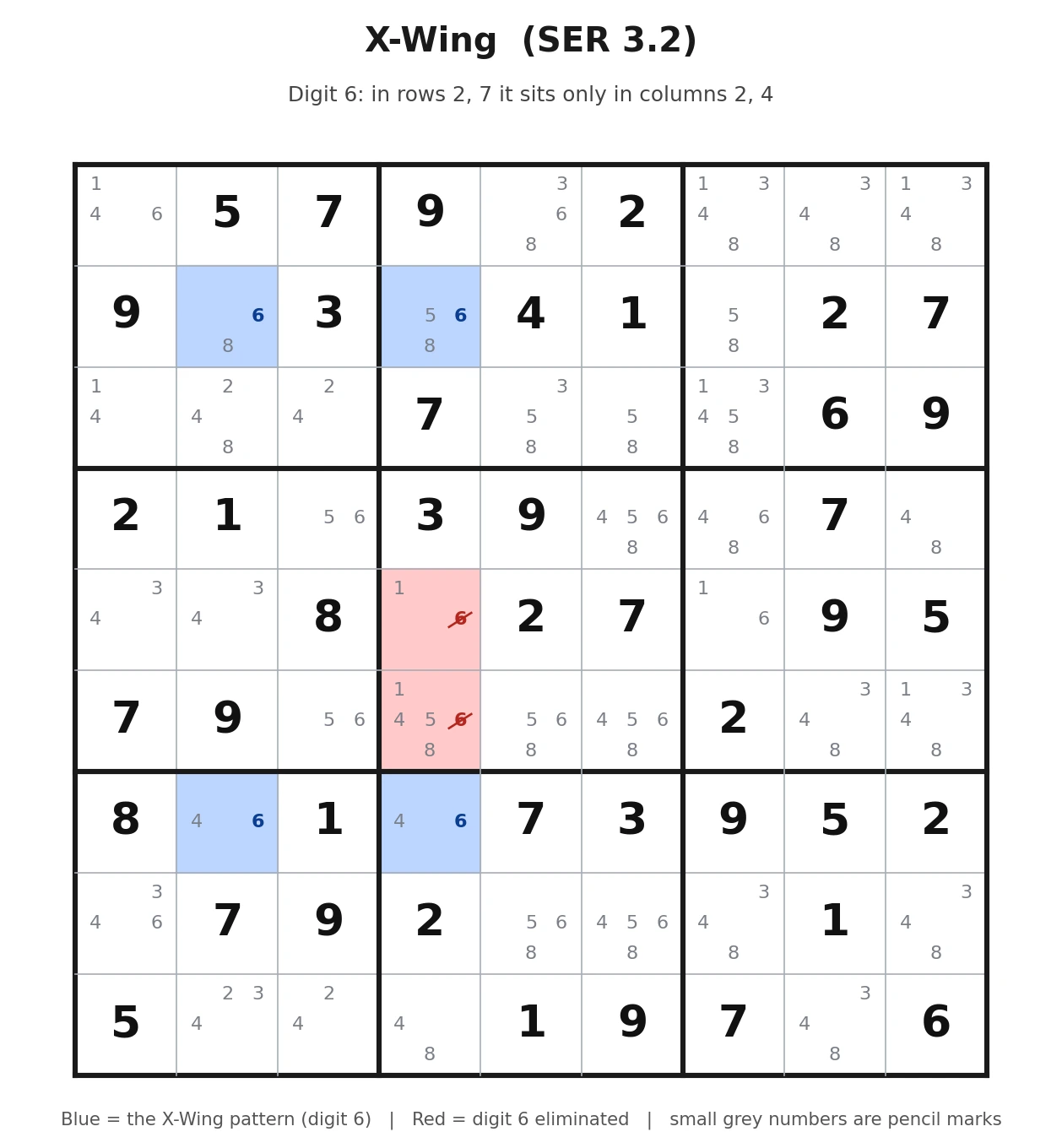
This is a real board mid-solve, with the pencil-mark candidates shown small in grey. Digit 6 can only land in columns 2 and 4 across rows 2 and 7 (the blue cells). Because those two rows have to use those two columns for their 6, you can erase 6 from the rest of those columns (the red cells). SER 3.2. It is the first "real" technique most solvers learn.
What is a Swordfish
A Swordfish is an X-Wing that grew a row. Instead of two rows and two columns, it uses three rows where a digit is confined to the same three columns. Same logic, bigger net: the digit gets eliminated from those three columns in every other row.
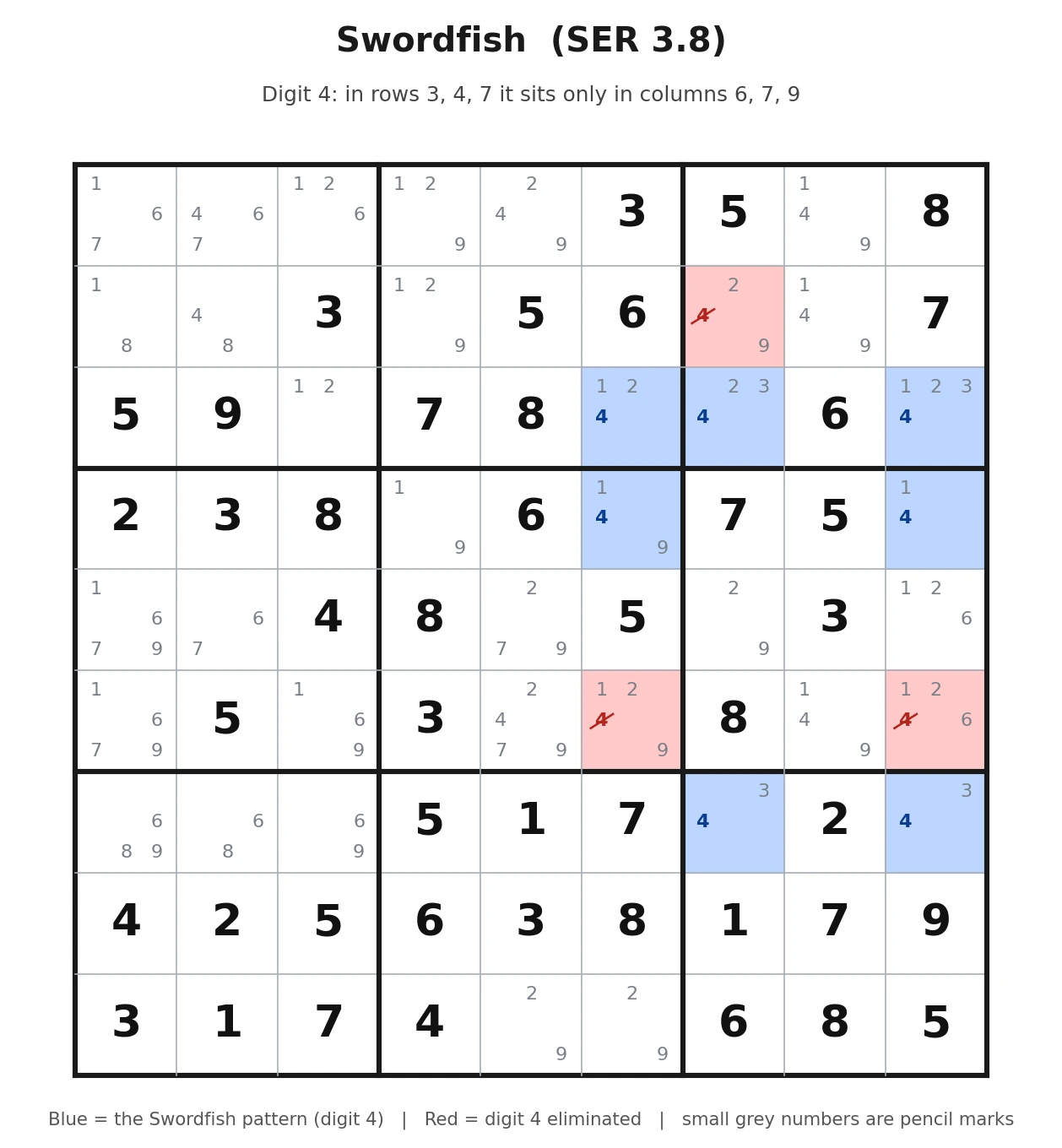
Here digit 4 lives only in columns 6, 7, and 9 across rows 3, 4, and 7 (the blue cells). Each row uses two or three of those columns, which is allowed. The eliminations land in those same columns elsewhere (red cells). SER 3.8.
What is a Jellyfish
Keep going and you get the Jellyfish: four rows, four columns, one digit. It is the biggest of the basic fish, and it is the hardest of the four moves on this page at SER 5.2.
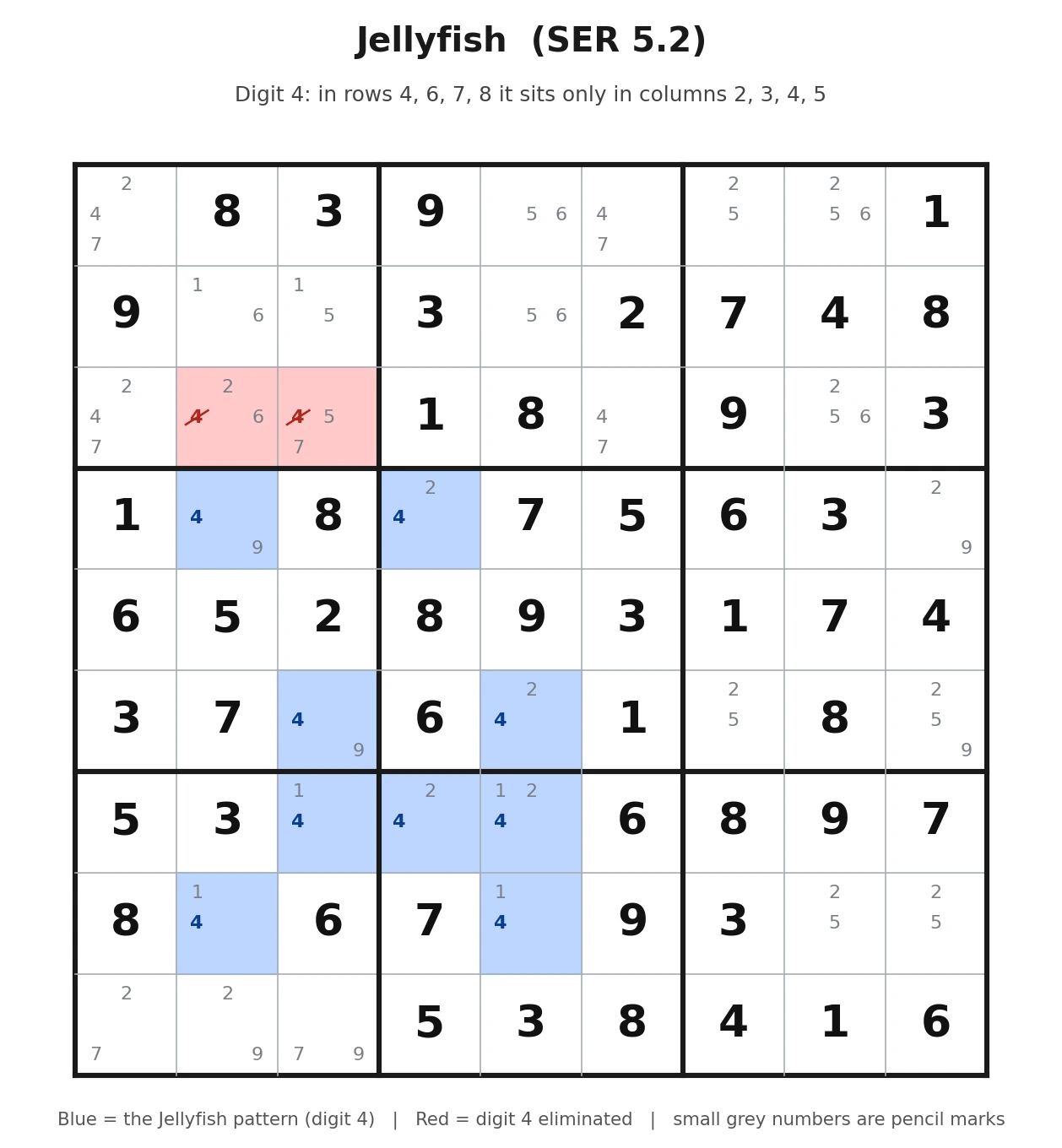
Digit 4 is confined to columns 2, 3, 4, and 5 across rows 4, 6, 7, and 8 (the blue cells). Because those four rows can only place their 4 inside those four columns, 4 is gone from those columns in the remaining rows (the red cells). Fish do not get bigger than this in practice, since a five-row fish is mathematically covered by its leftovers.
What is an XY-Wing
The XY-Wing leaves the single-digit world and uses three cells that each hold exactly two candidates. One cell is the pivot, the other two are pincers. Whatever the pivot turns out to be, one of the two pincers is forced to a shared third digit. So any cell that can see both pincers cannot hold that digit.
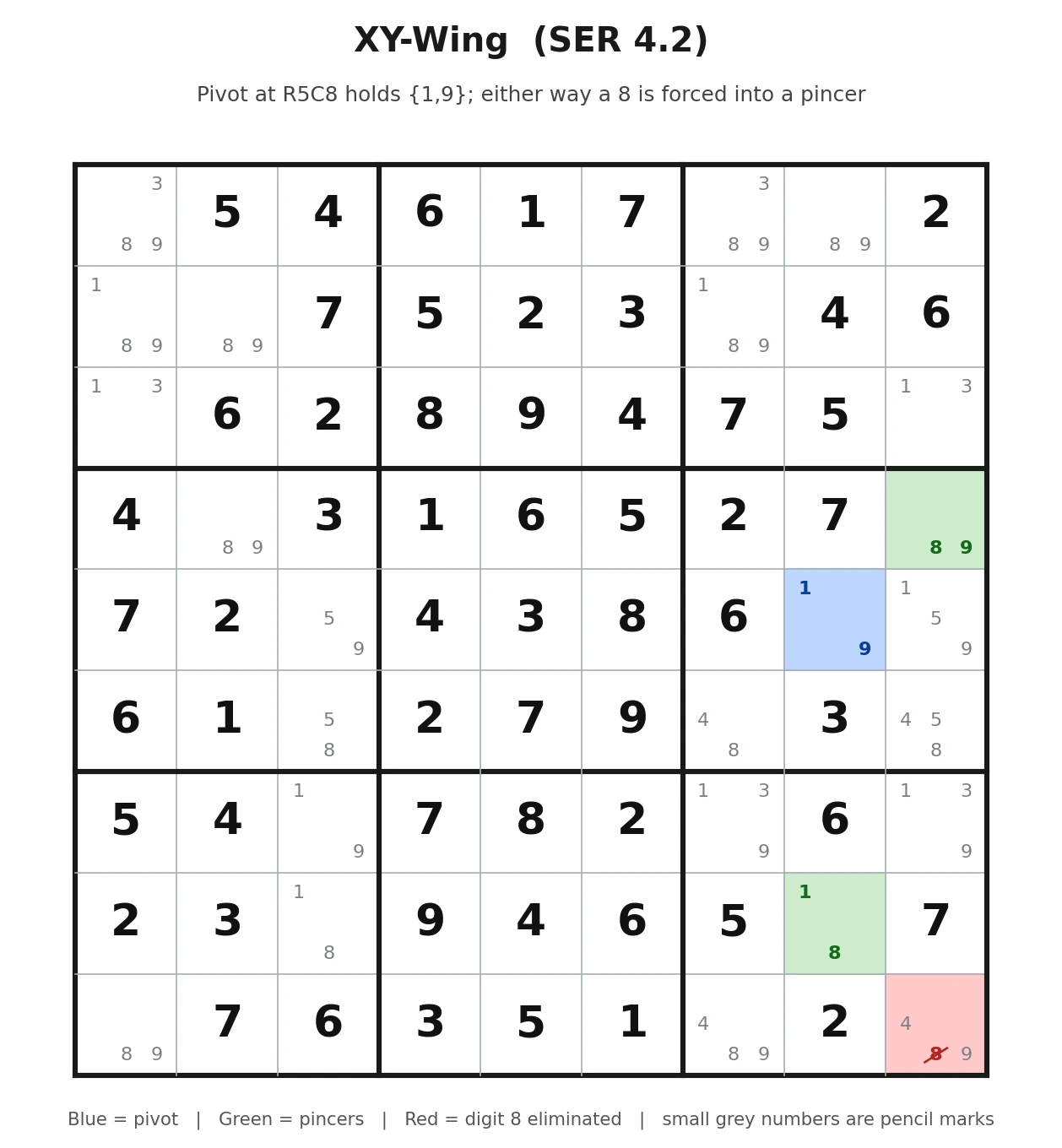
The pivot here (blue) holds 1 and 9. One pincer (green) holds 9 and 8, the other holds 1 and 8. Whichever way the pivot falls, an 8 gets forced into one of the pincers, so the red cell that sees both pincers cannot hold an 8. SER 4.2. This is the move that teaches you to think in "if this, then that" chains, which is the door to everything above SER 6.
So what does SER 8.5 to 9.5 actually require
Here is the part that matters if you want a genuinely brutal book. Everything on this page tops out at SER 5.2. The puzzles in my hardest two volumes start where the fish end and keep climbing. SER 8.5 to 9.5 means the puzzle cannot be cracked by any wing or fish at all. It demands dynamic forcing chains: long "if this cell is 4, then that one is 7, then this contradiction appears" sequences that you hold in your head across the whole grid.
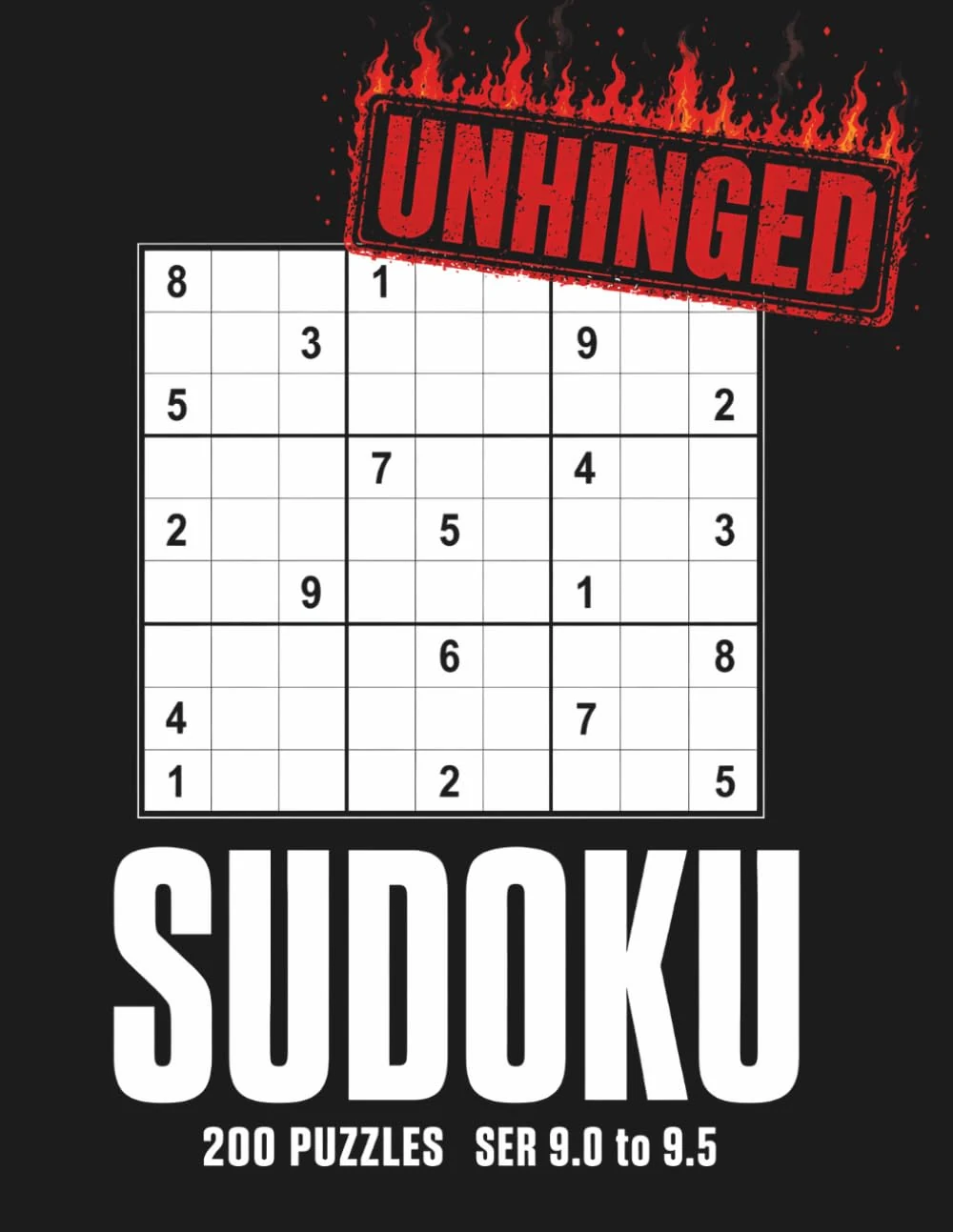
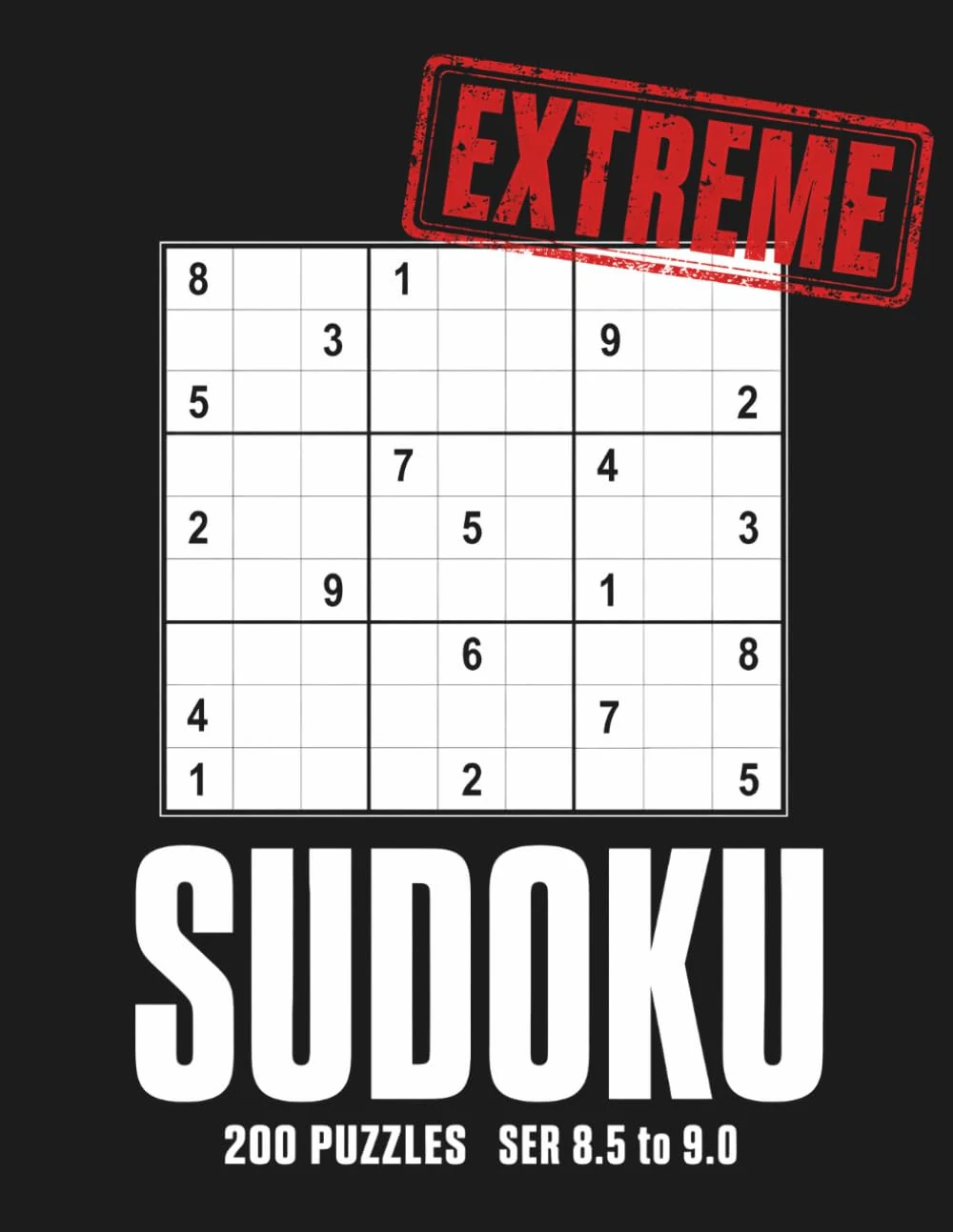
That is the line my two top books are built on, with the rating printed so the cover is not lying to you. The Extreme Sudoku, SER 8.5 to 9.0 volume is the place to start if you have already beaten everything labeled "expert." The Unhinged Sudoku, SER 9.0 to 9.5 volume is the step past that, and it is the hardest sustained set I publish.

If you want a fuller comparison of the hard end of the catalog, the hardest sudoku books roundup lines them up by rating.
What is a good SER for a hard sudoku?
For most solvers who want a real challenge, SER 6 to 7.5 feels "hard," since it starts requiring forcing chains. SER 8.5 and up is the territory reserved for people who solve daily and want to be genuinely stuck. Anything below SER 3 will feel easy to a regular solver.
Is an X-Wing a hard sudoku technique?
No. An X-Wing rates SER 3.2, which is lower-middle difficulty. It feels hard the first time because it is the first technique that looks at a digit across the whole board instead of one box, but it is an entry-level "advanced" move, not an extreme one.
What is the highest possible SER?
In practice the hardest human-relevant puzzles land around SER 11.0, such as the AI Escargot grid. Ratings above that exist but represent puzzles that are essentially solved by guessing, so they stop being meaningful as a difficulty measure.
How is SER different from a star rating?
A star rating or an "easy/medium/hard" label is set by whoever made the book, so it means something different on every cover. SER is produced by a fixed program rating the actual logic the puzzle requires, so the same grid always gets the same number no matter who runs it.
The whole reason I rate puzzles this way is so the word on the front means something. If you want to see where you sit, learn the four moves on this page, then go pick a fight with the Unhinged Sudoku, SER 9.0 to 9.5 volume and find out where the wall is.
As an Amazon Associate, Pixel Wizard Press earns from qualifying purchases.